- March 22, 2026
- by anilraikwarseo
- SEO Niche
Search Engine Optimization (SEO) is not just a digital marketing technique—it is a fundamental process that connects users with the right information on the internet. Whether you are a blogger, business owner, or affiliate marketer, SEO plays a crucial role in helping your content reach the right audience.
In this detailed guide, we will explore the introduction, history, evolution, and core concepts of SEO, using practical explanations and insights.
The Most Important Line in SEO
Before understanding anything else, you must remember this:
“The foundation of SEO remains the same.”
Many beginners focus on shortcuts like hacks, tricks, or black hat SEO techniques. They try to find loopholes in search engines to rank quickly. While such methods might work temporarily, they are not sustainable.
Search engines—especially Google—continuously update their algorithms. If your website is ranking because of tricks or manipulation, it will eventually lose its position when the next update comes.
That’s why:
- Basics are more powerful than advanced tricks
- Strong foundation = long-term rankings
- Shortcuts = temporary success
If you implement SEO fundamentals properly, you often won’t need complicated strategies.
Understanding How Google Works
To understand SEO, you must first understand how Google works.
Google is an algorithm-driven search engine. It uses complex systems to decide which web pages should appear when a user searches for something.
Core Functions of Search Engines
- Crawling – Discovering web pages across the internet
- Indexing – Storing and organizing those pages
- Ranking – Displaying the most relevant pages to users
Types of Algorithms in Google
There are mainly two types of algorithms:
1. Core Algorithms
These are the foundation of Google’s system, and they rarely change.
Core principles include:
- If your content has value, it will rank
- If your content is relevant to the user’s query, it will rank
These are permanent truths in SEO.
2. Updated Algorithms
These are updates introduced over time to improve results.
For example:
- Mobile-friendliness became important later
- Page speed became a ranking factor
- User experience signals were introduced
These updates are built around the core foundation, not replacing it.
SEO is a Set of Practices
SEO is not a single task—it is a process.
SEO is a set of practices designed to improve the appearance and positioning of web pages in organic search results.
These practices are not random. They are based on Google’s recommendations and best practices.
If you understand:
- What Google recommends
- Why it recommends those things
Then you can naturally perform SEO without relying on tricks like:
- Keyword stuffing
- Content spinning
- Black hat techniques
The Evolution of SEO
1. Growth of the Internet
As the internet became popular, thousands of websites started being created daily across different niches like:
- Education
- Travel
- News
- Entertainment
However, there was a major problem:
👉 Users didn’t know these websites existed.
2. The Problem: Too Many Websites
Website owners (businesses and individuals) created websites for users. But users had no way to discover them.
This created a gap:
- Websites existed
- Users existed
- But there was no connection
3. Web Directories
To solve this, web directories were introduced.
These directories categorized websites into sections like:
- Education
- Travel
- Business
- Entertainment
But as websites grew rapidly, directories became inefficient and difficult to manage.
4. Birth of Search Engines
This problem led to the creation of search engines.
Early search engines like Yahoo allowed users to search for websites using queries.
Users could now:
- Enter a query
- Get relevant results
This was a major breakthrough.
5. Entry of Google
Later, Google entered the market and changed everything.
Google focused on:
- Understanding user intent
- Delivering relevant results
- Improving user experience
While earlier search engines failed to adapt, Google succeeded because it prioritized users.
That’s why today:
- Most SEO efforts are focused on Google
- Even professionals rarely optimize primarily for other search engines
How SEO Came Into Existence
As businesses realized the importance of online visibility, they wanted their websites to appear at the top of search results.
Example:
A business offering digital marketing services wants to rank for:
👉 “digital marketing services”
But many competitors also want the same.
So the question became:
👉 How does Google decide who ranks first?
To answer this, people started:
- Studying search engines
- Understanding ranking factors
- Following best practices
Search engines themselves provided guidelines.
Following these guidelines became what we now call:
👉 Search Engine Optimization (SEO)
Categories of SEO
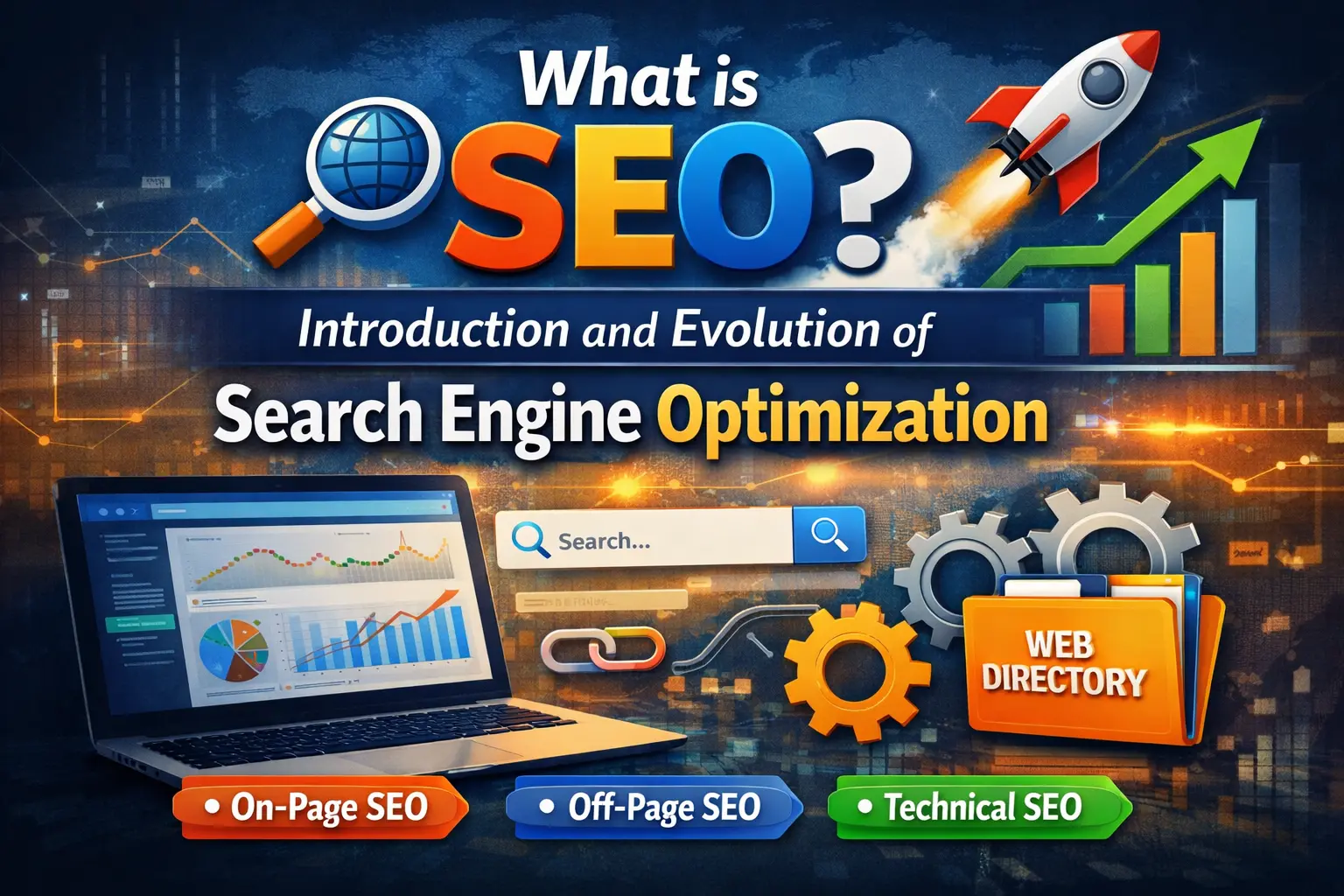
SEO is divided into three major categories:
1. On-Page SEO
On-page SEO includes all changes made within your website.
Examples:
- Content optimization
- Keyword placement
- Heading structure (H1, H2, etc.)
- Internal linking
These are directly based on Google’s recommendations.
2. Off-Page SEO
Off-page SEO focuses on building your website’s authority externally.
Mainly includes:
- Backlinks (links from other websites)
- Link-building strategies
- Brand mentions
The goal is to show search engines that your website is trustworthy.
3. Technical SEO
Technical SEO ensures your website performs well technically.
Includes:
- Website speed
- Mobile-friendliness
- SSL certificates (security)
- Proper crawling and indexing
For example:
Earlier, mobile-friendliness was not important.
But as mobile usage increased, Google made it a key factor.
Why Following Google’s Recommendations Matters
All SEO practices are based on Google’s guidelines.
If you ignore these:
- Your website may rank temporarily
- But future updates can remove it from rankings
If you follow them:
- Your website becomes future-proof
- Rankings become stable
SEO is Not a Fixed Formula
One of the biggest misconceptions is:
👉 SEO is not “2 + 2 = 4”
It is relative and competitive.
Example:
- If your competitors are weak → You rank faster
- If your competitors are strong → You need more effort
So SEO depends on:
- Competition
- Content quality
- Optimization level
Who Uses SEO?
SEO is used by many types of people:
1. Bloggers
Bloggers create content and rank it to:
- Get traffic
- Earn through ads (like AdSense)
- Get sponsorships
2. Business Owners
Businesses use SEO to:
- Reach potential customers
- Increase sales
- Grow online presence
3. Affiliate Marketers
Affiliate marketers:
- Create content
- Rank it on search engines
- Promote products
- Earn commissions
The Right Mindset for SEO
Instead of asking:
❌ “How can I rank quickly?”
Ask:
✅ “How can I become better than my competitors?”
Success in SEO comes from:
- Consistency
- Understanding fundamentals
- Following best practices
Final Thoughts
SEO is not a shortcut—it is a long-term strategy built on strong fundamentals.
From web directories to modern search engines, the goal has always been the same:
👉 Deliver the most relevant content to users
If you:
- Understand Google’s recommendations
- Build a strong foundation
- Focus on quality and relevance
Then SEO will become simple and effective for you.