On-page SEO services in India, done page by page

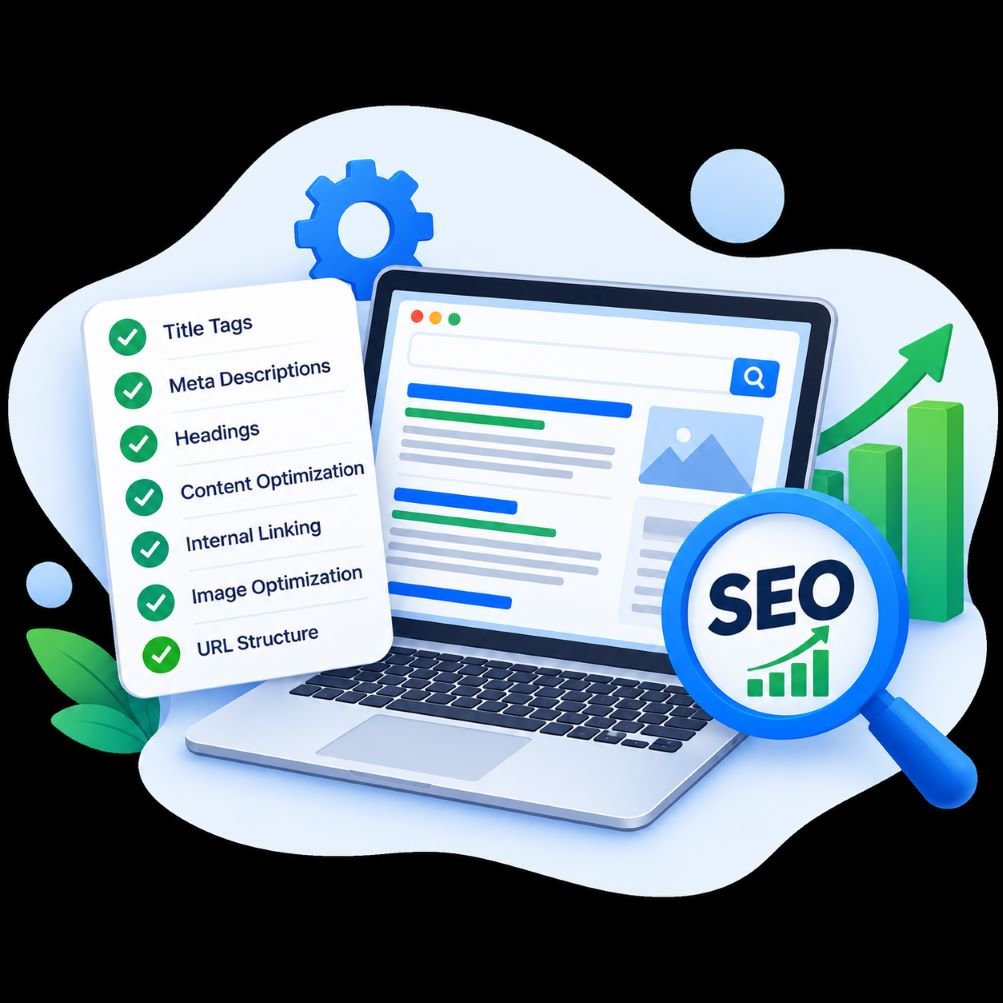
On-page SEO is work on your own pages to be understood by search engines and AI assistants, and chosen by people. It includes title tags, meta descriptions, headings, content, internal links, images, URLs and structured data. We audit each page to fix what is holding it back and watch the change in Google Search Console.

Title tag

Primary keyword first, 50 to 60 characters, and a reason to click. Written for each page, never duplicated across the site.

An example page, and the six things I check first

Interactive on-page SEO demo. A sample search result and page preview with six clickable elements. Selecting one highlights it and shows a short explanation. It plays through once on load and stops when the visitor interacts.

  • Title tag: Main keyword first, 50 to 60 characters, and a reason to click. Written for each page and never duplicated.
  • Meta description: 150 to 160 characters describing the page’s real offer, with the answer in the first line.
  • H1: One per page, stating the topic in the searcher’s own words.
  • Internal link: Descriptive anchor text from a related page, showing crawlers and AI systems how pages connect.
  • Image alt text: A specific, natural description for screen readers and image search, with no keyword stuffing.
  • Structured data: JSON-LD that matches the page, validated before it goes live.

What's included in on-page SEO service?

Every page gets the same review. Here is what I look at, what I change, and why each one matters.

On-page SEO elements, what I do for each, and why it matters
Element What I do Why it matters
Title tags Rewrite to 50 to 60 characters with the main keyword near the start and a clear reason to click. It is the first thing a searcher reads and a strong signal of what the page is about.
Meta descriptions Write 150 to 160 characters that describe the page's real offer, with the answer in the first line. Google often shows it as the snippet, so it shapes click-through rate.
Headings One H1 that states the topic in the searcher's words, then H2 and H3 headings that follow the questions people ask. Clear headings let crawlers and AI systems split the page into answerable sections.
Body content Compare against pages already ranking, fill the gaps, lead each section with a direct answer, and add examples and sources. Helpful, complete content is what earns rankings and citations.
Internal links Add links with descriptive anchor text from related pages, and fix orphan pages. They show how your pages connect and pass authority to the pages that matter.
URLs and canonicals Keep URLs short and readable, and make sure each page has one canonical version. It prevents duplicate-content confusion and keeps signals on one address.
Images Use descriptive file names and alt text, modern formats like WebP, and set width and height. It supports image search, accessibility and stable page layout.
Structured data Add JSON-LD that fits the page, such as Service, Article, Product, LocalBusiness or BreadcrumbList, and validate it. It gives search engines and AI systems explicit facts about the page and your business.
Trust signals Show the author, publish and update dates, contact details and sources. They help people, and quality systems, judge whether a page can be trusted.
Page experience Flag slow loading, layout shifts and heavy scripts that come from page templates, then pair the fix with technical SEO. A page people leave before it loads will not keep its rankings.

How an on-page SEO project runs

Six steps, in this order. You always know which pages are being worked on and what changed.

  1. Audit your pages

    I crawl the site and pull Search Console data to list every page with its clicks, impressions and problems. You get a short list of the pages worth fixing first.

  2. Check the search intent

    For each target keyword I look at what Google shows today: page types, headings, questions answered, and whether an AI Overview appears. Your page has to match that, or well-written tags will not save it.

  3. Write the page blueprint

    One row per page: target keyword, title tag, meta description, heading outline, internal links to add, schema type and content gaps.

  4. Make the changes

    I edit directly in WordPress, including Elementor pages. If a developer owns your site, I hand over an exact change sheet instead.

  5. Validate and submit

    I check the rendered HTML, test structured data, confirm canonicals and request indexing for your priority URLs in Search Console.

  6. Measure and adjust

    Once Google has recrawled, I compare clicks, impressions, click-through rate and positions with the starting point, then refine any page that under-performs.

Each page is aligned to what Google already rewards

A perfectly tagged page still fails if it is the wrong type of page for the search. If Google has comparison pages for a keyword, a sales page is not going to sneak in. So before I touch a title tag I look at the results and see what kind of page the keyword needs.

↗ VisibilityBetter rankings & clicks
01

Best CRM for small business

We research what people are really searching for, analyse the top results and create content that answers their questions — clearly and completely.

⌕
Search intent
Understand what people want
→
▤
Content
Create a clear, useful page
→
▥
Results
Rank, attract and convert
● Local reachReal customers nearby
02

SEO freelancer in Delhi

We create location-focused content that builds trust, answers common questions and helps you show up in local search results.

⌕
Search intent
People look for trusted local experts
→
●
Google shows
Local results, profiles and reviews
→
▤
Your page
Location, examples, process & contact
</>

Meta Description

Clear
Relevant
Compelling
↗ Better CTRMore qualified clicks
03

How to write a meta description

We show you how to write clear, focused and compelling meta descriptions that match search intent and get more clicks.

⌕
Search intent
Understand what users are looking for
→
▤
Content
Write simple, benefit-driven copy
→
▥
Results
Higher CTR and better rankings
↗ SalesTurn visits into orders
04

Buy attar online

We create product and category pages with clear information, attractive visuals and a seamless shopping experience that helps you get more orders.

⌕
Search intent
People browse products, compare prices and reviews
→
▢
Content
Showcase products, features and benefits
→
↗
Results
Get more visits, leads and sales
✦ AI Answers

Written so AI answers can quote you, too

People now get answers from Google AI Overviews, ChatGPT and Perplexity before they click anything. Google's own guidance treats optimising for these as the same work as SEO, applied to new places. So there is no separate trick. There are a few habits that make a page easy to understand and easy to quote.

What I won't promise. Nobody controls rankings or AI citations, so I don't guarantee either. I make your pages the clearest, most complete answer I can, then measure what happens.

✦
✧

The habits I build into every page

✓
Open each section with a direct answer of 40 to 60 words, then add the detail.
✓
Keep sections self-contained, so a passage still makes sense when it is quoted on its own.
✓
Name the author, show dates, and cite a source for every fact and figure.
✓
Use the same business name, description and contact details everywhere they appear.
✓
Put content and JSON-LD in the initial HTML, not only after JavaScript runs.
✓
Check robots.txt so the crawlers you want, such as Googlebot, OAI-SearchBot or PerplexityBot, are not blocked by accident.
Real Examples

What changes on a page:
an illustrative example

This is a fictional business, shown to make the work concrete. It is not a client result.

× Before
studiomehra.example › home

Home - Studio Mehra

×
Title says nothing about the service or the city.
×
Two H1 tags, one hidden in the slider.
×
Images named IMG_2041.jpg with no alt text.
×
No structured data.
✓ After
studiomehra.example › interior-design-delhi

Interior Design Services in Delhi

Full-home and single-room interior design in Delhi NCR. See our process, sample budgets and completed projects, then book a free site visit.

Book a Free Site Visit →
✓
Keyword-rich, service-focused title Includes the service and city for better relevance and ranking.
✓
One H1, H2s that match real questions Clear structure helps search engines and users understand the page.
✓
Descriptive file names, alt text and image dimensions Improves accessibility, image SEO and page performance.
✓
Service and BreadcrumbList schema, validated Helps search engines understand your content and can enable rich results.
💡
Better content structure Helps users and search engines find the right information.
◎
More relevant titles Attracts the right audience and improves relevance.
⌕
Optimized media Enhances accessibility, performance and visibility.
☆
Structured data Helps search engines understand content and eligibility for rich results.
Is this service right for you?

Who this service is for

We’re here to help the right people get real results. Here’s a quick guide to make sure this service is the right fit for you.

✓ A good fit if
✓

You run an e-commerce, real estate, healthcare, finance or local service website.

✓

Your pages exist but sit on page two or three, or get impressions and few clicks.

✓

You have a WordPress site, or a developer who can apply a change sheet.

✓

You want to rank in Google and show up in AI answers.

▥
Higher rankings,
better visibility
× Probably not the right fit if
×

You want guaranteed rankings or a guaranteed number of visitors.

×

Your site is not indexed yet, or has serious crawling problems. Start with a technical SEO fix first.

×

You want thousands of low-quality backlinks. I don’t do that.

website
×
⊘
Not indexed yet?
Get Your Site Optimized

Get Your Site Optimized &

Converting Right Now