- March 23, 2026
- by anilraikwarseo
- SEO Trends
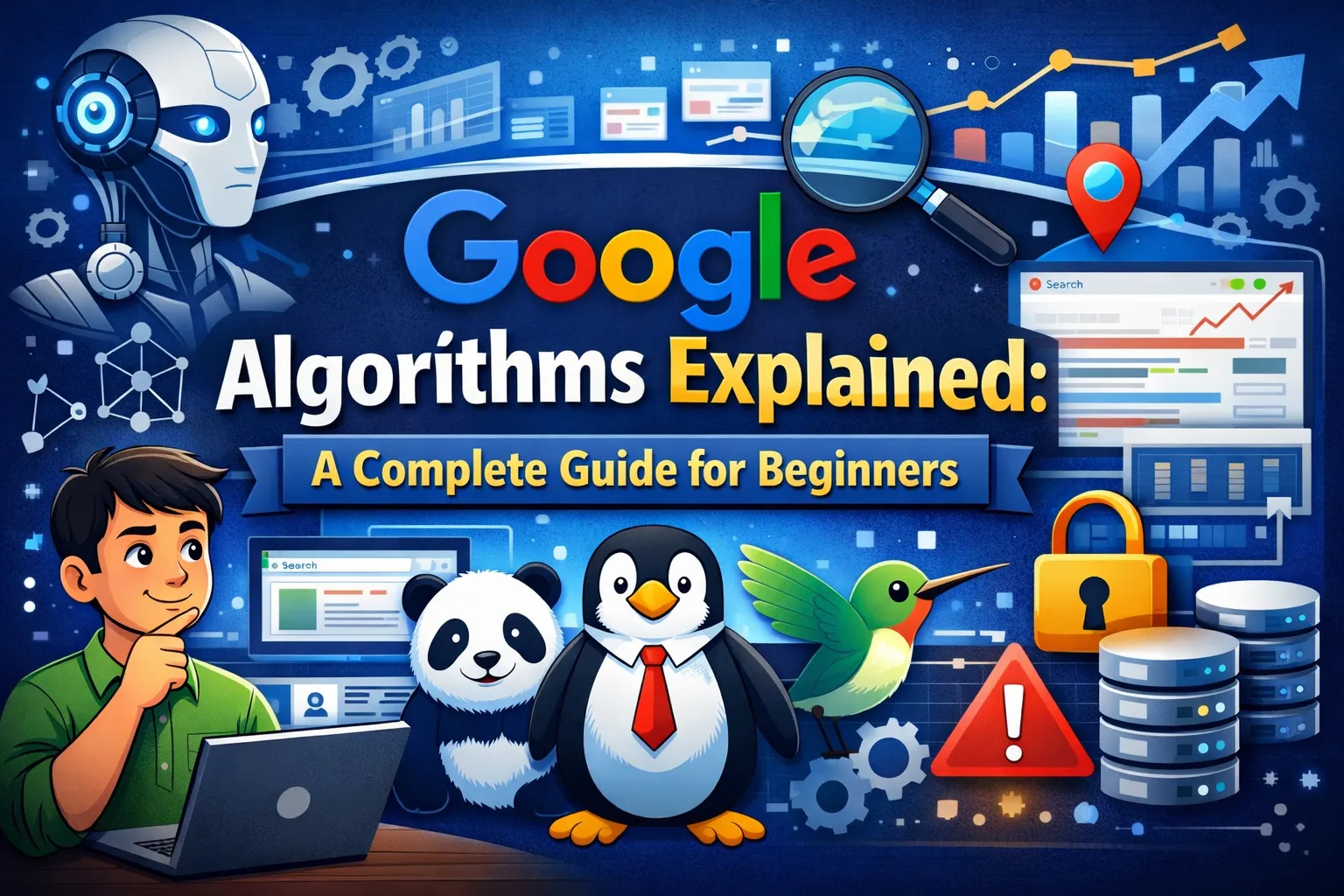
In this blog, we are going to learn about one of the most important concepts — Google Algorithms.
Whenever a user types a query into Google, within a fraction of a second, they see thousands or even millions of results on the Search Engine Results Page (SERP). But have you ever thought about how Google decides which website appears first, second, or third?
Is it random?
Is it based on luck?
Or is there a system working behind the scenes?
The answer is — Google Algorithms.
These algorithms are the backbone of Google Search. Every result you see is not manually selected by a human, but is generated through a highly advanced and constantly evolving system. These systems analyze multiple factors like content quality, relevance, user intent, backlinks, website performance, and many more — all within milliseconds.
In simple terms:
👉 Google algorithms decide which content deserves to rank and which does not.
Why Google Updates Its Algorithm
Google continuously improves its algorithm to:
- Improve user experience
- Eliminate spam and manipulation
- Promote genuine and helpful content
- Show relevant results based on intent
There are:
- Minor updates (happen frequently, often unnoticed)
- Major updates (officially announced and impactful)
Now let’s understand the major algorithm updates.
Major Google Algorithms
1. Google Panda (2011) – Content Quality Checker
Google Panda focuses on content quality.
It checks:
- Whether your content is original or copied
- Whether your content has proper depth
- Whether your content provides value
If your website has:
- Thin content (2–3 lines)
- Duplicate content
- Low-quality articles
👉 Panda will reduce your ranking.
Key takeaway:
Write meaningful, detailed, and valuable content.
2. Google Penguin (2012) – Backlink Spam Detector
Penguin targets Black Hat SEO techniques.
It checks:
- Unnatural backlinks
- Link farming
- Spammy link building
- Paid or automated links
If you try shortcuts like:
- Buying backlinks
- Using tools for bulk links
👉 Penguin will catch you and penalize your website.
Key takeaway:
Always build natural and genuine backlinks.
3. Google Hummingbird (2013) – Relevance & Intent
Hummingbird focuses on search intent and relevancy.
It ensures:
- Your content matches the user’s query
- Your page answers the actual intent behind the keyword
Important point:
It’s not about keyword stuffing anymore — it’s about understanding intent.
Example:
- Keyword: “Digital marketing course”
- Your content should fully explain the course, not just repeat the keyword
Key takeaway:
Focus on intent-based content, not just keywords.
4. Google Pigeon (2014) – Local Search Optimization
Pigeon improves local search results.
It checks:
- User location
- Business proximity
Example:
If a user in Delhi searches for “packers and movers”
👉 Google shows nearby Delhi businesses
Key takeaway:
Optimize your website for local SEO if you target local customers.
5. Google Payday (2013) – Spam & Misleading Content Filter
This update targets:
- Spammy niches (loans, casinos, quick money schemes)
- Misleading or fake content
If your website contains:
- Fake promises
- Manipulative content
👉 Your site may get penalized or removed from SERPs.
Key takeaway:
Avoid misleading content. Be genuine and transparent.
6. Mobilegeddon (2015) – Mobile Friendliness
This update checks:
- Whether your website is mobile-friendly
- Whether it works on all screen sizes
Google now uses:
👉 Mobile-first indexing
This means:
- Google checks your mobile version first
Key takeaway:
Your website must be responsive and mobile-optimized.
7. Google Fred (2018) – User Experience & Ads
Fred targets websites that:
- Focus too much on ads
- Provide poor user experience
Example:
- Too many ads covering content
- Bad placement of ads
👉 These reduce user satisfaction and ranking.
Key takeaway:
Balance content and ads. Always prioritize user experience.
How Google Algorithms Work Together
These algorithms are not separate anymore — they are part of Google’s core algorithm.
That means:
- Content quality (Panda)
- Backlinks (Penguin)
- Relevance (Hummingbird)
- UX & mobile (Mobilegeddon, Fred)
👉 All work together to decide rankings.
Important SEO Lesson
Many beginners think:
👉 “If I create backlinks, my website will rank.”
But this is incomplete.
If you ignore:
- Content quality
- User experience
- Relevance
👉 Your site will eventually get penalized.
How to Stay Safe from Google Penalties
Follow these best practices:
✅ Use White Hat SEO Techniques
- Avoid shortcuts
- Focus on long-term growth
✅ Create High-Quality Content
- In-depth and useful
- User-focused
✅ Build Natural Backlinks
- From real and relevant sources
✅ Focus on User Experience
- Fast loading speed
- Clean design
- Easy navigation
✅ Optimize for Mobile
- Fully responsive design
Google Is Becoming More User-Centric
If you observe all the major algorithms like Panda, Penguin, Hummingbird, and others, you will notice a common pattern:
- Panda focuses on content quality
- Penguin focuses on link authenticity
- Hummingbird focuses on relevance and intent
- Mobilegeddon focuses on mobile usability
- Fred focuses on user experience
All of them are moving in one direction:
👉 improving user satisfaction
Google’s ultimate goal is simple:
Keep users happy by showing the best possible results.
Because when users are satisfied:
- They trust Google more
- They spend more time on the platform
- They interact with ads (which generates revenue for Google)
So if you align your SEO strategy with this goal, you automatically align with Google.
Final Thoughts:
As we come to the end of this guide, one thing should be very clear — Google algorithms are not your enemy, they are your guide. Many beginners see algorithm updates as something to fear, but in reality, they are designed to reward the right practices and eliminate shortcuts.
Over the years, Google has evolved from a simple keyword-matching system to a highly intelligent, user-focused search engine. Earlier, ranking a website was easier with tactics like keyword stuffing or creating bulk backlinks. But today, things have completely changed. Google now understands user intent, content quality, engagement signals, and overall experience.
This shift tells us one important thing:
👉 SEO is no longer about tricks — it’s about value.